
Pomp and Circumstance
The Pomp and the Circumstance: A Field Guide to Civilizational Cope.

If the Catholic Church had the actual presence of God on its side, why did it need all that Baroque architecture?
You’re supposed to say “to glorify God” or “to inspire the faithful” but that’s not an answer, that’s a press release. The answer is that after Martin Luther nailed his complaints to a door and half of Europe defected, the Church found itself in the novel position of having to convince people it was worth listening to. So it did what any insecure institution does when the substance starts looking shaky: it cranked up the production value.
Massive domes. Gilded everything. Ceilings painted with illusory skies so you’d crane your neck toward heaven whether you wanted to or not. The architecture was designed, explicitly, to “arouse admiration, awe and humility” in visitors. Notice the order there. Admiration first, humility last. The building does the heavy lifting so the theology doesn’t have to.
This is the rule, and it has no exceptions: the volume of the spectacle is inversely proportional to the confidence in the substance. The louder the display, the quieter the actual achievement. The more elaborate the costume, the less impressive the person wearing it.
You already know this intuitively, which is why you’ve never trusted a man in a three thousand dollar suit who insists you call him Doctor.
II.
Walk into a courtroom in England or Australia and you’ll find grown adults wearing powdered wigs that went out of fashion before America existed. The tradition dates to the 17th century, when everyone wore them, partly as a style statement and partly because syphilis was eating through the aristocracy’s hairlines faster than they could grow replacements (do google this one). The wigs survived in courtrooms long after the disease and the fashion died.
Why? The official answer is “dignity and authority.” One British defender of the practice called it a “leveling” device because “everyone’s a bigwig.” Get it? Because they’re wearing big wigs. The British love a pun almost as much as they love a pointless tradition.
But here’s what the official answer doesn’t explain: if the law is just, and the proceedings are fair, and the judge is competent, why does any of this require a costume? A surgeon doesn’t need to dress like a medieval barber to remove your appendix. An engineer doesn’t wear Roman robes to design a bridge. Only professions that suspect you might not take them seriously enough resort to theatrical props.
A British chief justice pointed this out in the 1850s, mocking judicial wigs as “a grotesque ornament, fit only for an African chief,” and wondering aloud why they were “indispensably necessary for the administration of justice.” He lost that argument. The wigs stayed. Because the people who benefit from unearned reverence will always fight hardest to keep the reverence machine running.
Here’s the test: if you strip away the pomp and the institution loses respect, that respect was never real. It was rented.
III.
Nowhere is the inverse relationship between substance and spectacle more obvious than in the grand tradition of the military parade.
Countries that actually have power don’t need to march it down the street. The United States, for all its flaws, has never felt the need to wheel ICBMs past the Washington Monument on an annual basis. It doesn’t have to. Everyone already knows. When Donald Trump floated the idea of a big military parade, the response ranged from mockery to horror, because Americans correctly understood that this is what tinpot dictators do, not superpowers. The world’s most powerful military has nothing to prove to anyone.
But swing by Pyongyang for Kim Jong Un’s birthday and you’ll see enough military hardware to invade a medium sized planet. Tanks. Missiles. Jets. Soldiers goose stepping in terrifying synchrony. The message is supposed to be “behold our might” but the actual message, to anyone paying attention, is “we are deeply worried you might not behold our might.”
Confidence is silent. Insecurity is loud.
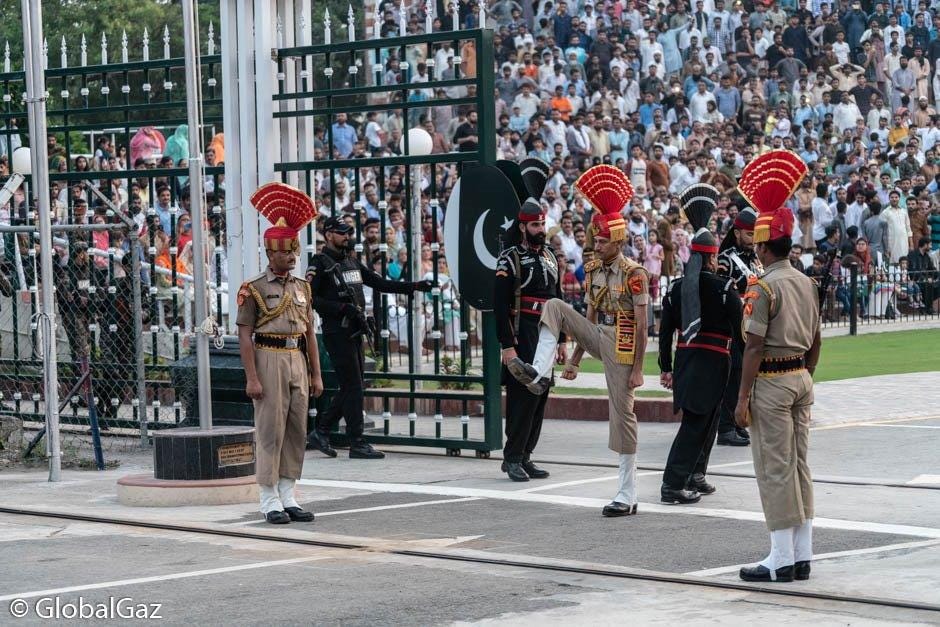
The most cartoonish example of this principle plays out every single day at the India Pakistan border crossing at Wagah. Every sunset, soldiers from both nations engage in a forty five minute ceremony that can only be described as competitive aggressive walking. They march at each other in exaggerated high kicks. They puff their chests. Their eyes bulge. They stomp so hard they used to injure their knees. Chauvinism at its most camp. Pantomime aggression that is somehow ferocious, ludicrous, and touching all at once.
The ceremony concludes with both sides slamming their respective gates in each other’s faces while crowds roar nationalist slogans, each trying to drown the other out. It’s nationalism reduced to pure performance, a daily reminder that the less secure two parties feel about their identities, the more elaborate their ritual posturing becomes. The whole thing started in 1959, right after the trauma of partition. Two new countries, bleeding from the same wound, trying to assert themselves into existence through synchronized stomping.
IV.
You’re probably feeling pretty good right now, sitting there in your normal clothes, not wearing a wig, not goose stepping anywhere. This isn’t about you.
Except it is.
Ever made a grand plan for self improvement? Really mapped it out? Maybe bought a new planner, some colored pens, set up a Notion workspace with seventeen nested databases? And then felt so good about the planning that you kind of... didn’t do the thing?
Congratulations, you’ve discovered psychological pomp.
The brain doesn’t distinguish very well between doing something and performing the rituals around doing something. When you write down a task and check it off, you get a small dopamine hit. When you announce your intentions to others and receive acknowledgment, your brain registers it as a “social reality” and gives you credit as if you’d already accomplished it. Researchers have known this since 1933. Tell people you’re going to write a novel and bask in their impressed reactions, and your motivation to actually write the novel drops. You already got the reward. Why do the work?
This is why every January you see people posting their ambitious fitness goals and new meditation practices and language learning apps, and by February the gym is empty again. The announcement was the point. The to do list was the point. The ceremony of preparation provided enough satisfaction that the actual preparation became optional.
We perform the rituals of achievement because rituals are easier than achievement. We create elaborate containers for work we’ll never do. We buy running shoes before we run. We research productivity systems instead of producing things. We spend an hour color coding a schedule for a project we’ll abandon in three days.
The to do list is your parade. The planner is your Baroque cathedral. The announcement is your powdered wig.
V.
There’s a particular species of pomp that has flourished in the social media era: the professional title as identity shield.
An actually brilliant scientist, the kind who’s changed their field, will often tell you to call them by their first name. The title is incidental. Their work speaks. Meanwhile, someone with a fresh doctorate in a field nobody’s heard of (intersectional intersectionality), someone who suspects they might not be taken seriously, will correct you if you forget the “Doctor.” Every email signature will include it. Every introduction will feature it. The credential becomes a talisman against disrespect, which is another way of saying it becomes a confession of expected disrespect.
Insisting on an honorific always backfires. People can tell. If you have to demand respect, you’ve already lost it. Truly accomplished people shed titles like unnecessary weight. The insecure collect them like armor.
This extends beyond academia. Any context where someone demands you acknowledge their status before they’ll engage with you is a context where that status is doing the work the person can’t do themselves. It’s the courtroom wig problem again. If you need the costume to command attention, the attention isn’t really for you.
Or consider the slightly touchier topic of compelled labels in general. In a healthy interaction, respect flows naturally. You don’t need to legislate it because people with genuine mutual regard figure it out. But when someone opens every conversation with a list of requirements for how they must be addressed, they’re essentially saying: “I don’t trust that you’ll respect me unless I force you to jump through these hoops.” Which might be true. But the hoops don’t create respect. They create compliance. And compliance that has to be demanded is just ceremony wearing respect’s clothes.
Real respect never needs to be compelled. If it did, it wouldn’t be respect.
VI.
Something has changed, and it’s not what you think. The old pomp and circumstance machines aren’t sputtering because people finally saw through them. They’re sputtering because someone figured out how to run them in reverse.
In August 2023, Donald Trump became the first former president in American history to have his mugshot taken. The moment was supposed to be humiliating. A booking photo at Fulton County Jail, scowling into the camera like a common criminal, processed for racketeering charges. The kind of image that ends political careers. That was the theory.
Within ninety minutes of his release, the Trump campaign was selling merchandise with his face on it. T shirts. Coffee mugs. Beverage coolers. The slogan: “NEVER SURRENDER.” It became the campaign’s best fundraising day ever, hauling in over seven million dollars. Art critic Jerry Saltz called it “the most famous photograph in the world” and noted that Trump had transformed his portrait into “a symbol as diabolically ingenious as the red MAGA hat.” Today, a gold framed copy of that mugshot hangs in the hallway just outside the Oval Office. His official presidential portrait recreates the same expression.
The playbook used to be: your enemies mock you, you demand they stop, you threaten consequences, you insist on your dignity. The new playbook is: your enemies mock you, you steal the joke, you sell it back to them.

Joe Biden called Trump supporters “garbage” during a campaign rally. The next day, Trump rolled up to Wisconsin in a branded garbage truck, wearing a bright orange safety vest, taking questions from reporters through the window. “How do you like my garbage truck? This truck is in honor of Kamala and Joe Biden.” The truck later appeared in his inauguration parade. The insult became a trophy.
But the true master class came from JD Vance.

After a contentious meeting with Ukrainian President Zelensky in February, critics edited Vance’s photos to give him a bloated face, widened eyes, and absurd curly hair. The “Fat JD” meme proliferated everywhere. Users photoshopped him as Violet Beauregarde from Willy Wonka. As a Minion. As the Las Vegas Sphere. The mockery was relentless.
On Halloween, Vance posted a video of himself at the Naval Observatory wearing a curly brown wig, recreating the meme exactly. “Happy Halloween, kids,” he says, grinning. “Remember, say thank you!” Then he spins under purple lights to the Twilight Zone theme. The post hit 57 million views. Elon Musk responded with a laughing emoji. One commenter wrote: “JD just won 2028.”
The Trump administration has made this into an art form. When Vanity Fair published unflattering photos of White House officials, including a bizarre shot of Secretary of State Marco Rubio standing in a corner staring at a lamp like a punished child, Rubio’s response was to make it his profile picture on X. “#NewProfilePic,” he captioned it. Vance piled on: “I guess I owe that guy $1,000.” (A reference to a joke he’d made during the photoshoot: “I’ll give you $100 for every person you make look really shitty compared to me. And $1,000 if it’s Marco.”)

The Department of Homeland Security posts deportation videos set to the Pokémon theme song. When Trump saw the display panel in Elon Musk’s Tesla, his awestruck “Wow, that’s beautiful... everything’s computer!” went viral, and even his critics had to admit they found it charming. The White House communications team operates like a meme account with nuclear codes.
This is not the same thing as being humble. Make no mistake. This is weaponized anti pomp.
The old guard demanded reverence and punished mockery. The new guard lets you mock them, then steals your joke, monetizes it, hangs it in a gold frame, and dares you to keep laughing while they’re laughing with you. The mugshot that was supposed to be shameful becomes a symbol of defiance. The insult becomes the merchandise. The caricature becomes the Halloween costume.
It’s brilliant and it’s terrifying and it’s the logical endpoint of everything we’ve been discussing. If pomp and grandeur are defensive mechanisms against the fear of not being taken seriously, then this is the opposite: a total refusal to even pretend the ceremonial matters. You can’t puncture someone’s dignity if they beat you to the punchline. You can’t embarrass someone who’s already wearing the clown costume and charging admission.
The emperor has no clothes, and the emperor’s response is to start an OnlyFans.
VII.
So what have we learned?
That the impulse to signal greatness is nearly always a substitute for achieving it. That insecurity dresses itself up in gold because it’s terrified you’ll notice how naked it is underneath. That the most confident people and nations are the ones who feel no need to remind you they’re confident.
The weak parade. The strong work.
The pointless credential demands acknowledgment. The meaningful one doesn’t need to.
The fresh convert screams the loudest about the faith. The genuine believer prays quietly.
Your to do list feels productive because it’s a ceremony of productivity, and ceremonies are so much more pleasant than the sacrifice they’re meant to celebrate.
Every grand display is a question masquerading as a statement. “Am I enough?” says the military parade. “Am I legitimate?” asks the powdered wig. “Am I respected?” demands the angry insistence on titles. The answer, in every case, is: if you have to ask, you already know.
And yet.
There’s a wrinkle now. We’ve watched the cleverest operators figure out that the game has changed. That in an age where mockery travels faster than majesty, the winning move is to mock yourself first, hardest, and for profit. Turn your mugshot into a fundraising bonanza. Turn the insult into the slogan. Turn the caricature into the costume.
This feels like liberation but it might be something else. The old pomp demanded you kneel; the new anti pomp demands you laugh. But neither asks you to think. Neither requires competence. The man in the curly wig got 57 million views; what legislation did he pass that week? The garbage truck was a brilliant media stunt; what problems did it solve?
The danger isn’t just empty ceremony anymore. The danger is that we’ve swapped one kind of theatre for another and called it authenticity. The old emperors insisted they were clothed when they weren’t. The new emperors strip naked, monetize the footage, and dare you to look away. In both cases, nobody’s asking what the emperor actually accomplished while everyone was staring at his wardrobe choices.
The loudest gong has the biggest crack. The tallest statue guards the emptiest throne. The most elaborate ceremony masks the simplest insecurity. And now, the most aggressive self deprecation might be the newest mask of all.
Real greatness still doesn’t need a parade. It never needed one. But it also doesn’t need a meme account.
Go build something worth celebrating. Not worth posting. Not worth selling. Worth celebrating.